Monday, 30 November 2015

HTML Lecture 3

HTML Styling 
Every html has it's own style (The Background color is white and the test color is black).

We can  change html element style with the help of  Style Attribute. 

How to Change background color ?
your answer is given bellow.:

Attribute or tag used to change the background color is : 

style = "property : value" 

Example : 

<body>
                <h1 style style ="color : blue" > Your text </h1>
               <p style ="color : red > Your text </p>
                
</body>

Result :


Sunday, 29 November 2015

Barriers to Communication


There are many reason that why the communication may fail. In communication the message (What the said) is not convey clearly to the receiver. So it’s important to seek feedback of that message for the communicatior that their message is clearly understood or not.
            There are many communication barriers and may they accure at any stage during the communication process. The barriers may leads to your message distorted and there’ll be the risk of your money and time too. The Effective business communication used to overcome these barriers. 
There are some types of barriers to communication is given below :
Þ    Language barriers
Þ    Physiological barriers
Þ    Physical barriers
Þ    Systematic barriers
Þ    Attitudinal barriers
Language Barriers : زبان
                        Language and linguistic ability may acts as a barriers to communication
There are alot of languages in the world . mostly every culture has it’s own language for example pashto, urdu , english, spanish, british, punjabi, etc. If a Punjabi’s person is not familiar with the english so it’s acts like a barriers in communication  and vice versa.
However , even when communicating in the same language , the terminology in used in the message may act as a barrier to communication. The used of a jargon and the a lot of abbreviation with which the receiver is not familiar , it occur the problems in the communication.
 Physiological Barriers : جسمانی
                        The psychological state of the communicators will influence how the message is sent, received and perceived
Stress, if someone is stressed they may be preoccupied by personal concerns and not as receptive to the message as if they were not stressed.
Anger is another example of a psychological barrier to communication, when we are angry it is easy to say things that we may later regret and also to misinterpret what others are saying.

Reduce hearing , a receiver with reduced hearing may not grasp to entirety of a spoken conversation especially if there is significant background noise.

Physical Barriers : 
                        “The Example of physical barrier to communication is the geographical distance between the sender and the receiver
Communication is generally easier over shorter distances as more communication channels are available and less technology is required. Although modern technology often serves to reduce the impact of physical barriers, the advantages and disadvantages of each communication channel should be understood so that an appropriate channel can be used to overcome the physical barriers.

Systematic Barriers : 
نظام
                        Systematic barriers may exists in the structure or organisation where there are the inappropriate(غیر فعال یا غیر مناسب) and unimportant information system and communication channels , or where there is a lack or understanding the role and the responsibilities for the communication process. In such systems or organizations the systematic barriers may produced great problems.
Attitudinal Barriers رویوں
                        “Attitudinal barriers are behaviour or perceptions that prevent people from communicating effectively.

                        Attitudinal barriers to communication may result from personality conflicts, poor management, Resistance to Change or a Lack of Motivation.  Effective receivers of messages should attempt to overcome their own attitudinal barriers to facilitate effective communication.

regard : Rana Sarmad

Download Barriers to communication

Saturday, 28 November 2015

Computer Software Free

Downlaod Free pc softwares... 
Simple Steps for download 
1 : Click on download 
2 : wait for 5 Sec and click on skip add

3 : Download and enjoy


Networks

NETWORK’s
There are three types of networks.
1.      LAN (Local Area Network)
2.      Wan (Wide Area Network)
3.      MAN (Metropolitan Area Network)

LAN (Local Area Network):
                        LAN stands for local area network. It’s a collection of computers, usually personal computers , that share hardware, software and data. In simple tems LAN’s holds the personal computers through the media and so each personal computer can shate the resourse of the other. As the name implies, LAN’s cover short distances, such as with in campus, builiding, or office.
LAN’s Components :
            Lan’s don’t use telephone lines for sharing the resources, it’s used the speacial components:
  v  To share the computer systems we need some resources . that’s why in LAN’s networks the Network cables are used to connect all computers. Somtimes coaxle cable may be used. The difference between network cable and coaxle cable is the speed. Coaxle cable have more speed than network cable. Moreover computers can be connected with wireless connection but it’s slower than the both (network cable & coaxle cable).
  v  A network card oftern called as NIC card.  It’s the card used in the wiring to connect the computers. In desktop computers it fit’s in the slot expension in the cpu.  NIC used to determines the speed , message, sending and receiving of the data transmission.
   v  Bridge , it is used to connect the similar networks using same protocol.
  v Gateway, it is used to connect with the computers on the other networks. It’s the collection of hardware/software that let’s the computer to communicate with other computers on dissimilar networks. One of the main task of the gateway is protocol conversion.
  v  Base Station : a Wireless access point often called base station is used to connects to a wired area networks provides wireless transmit / receive capabilities over a radius of several hundered feet. Even through non-metal walls, computers can connect with wireless NIC’s to the network through these access points. 

Metropolitan Area Networks (MAN):

A metropolitan area network, or MAN (plural: MANs, not MEN) is basically a bigger version of a LAN and normally uses similar technology. It might cover a group of nearby corporate offices or a city and might be either private or public. A MAN can support both data and voice, and might even be related to the local cable television network. A MAN just has one or two cables and does not contain switching elements, which shunt packets over one of several potential output lines.


Wide Area Network (WAN)

A WAN is a data communications network that covers a relatively broad geographic area (i.e. one city to another and one country to another country) and that often uses transmission facilities provided by common carriers, such as telephone companies.


HTML Lecture 2

HTML Lecture - 2
·         In html 5 the starts of the document must be declare. And the declaration is  <doctype html>
·         The HTML document itself start with the <html> and ends with </html>
·         The visible part of the document is in <body> and </body>
Paragraph Tag

The HTML paragraph starts with the tag <p> and ends with the </p>
For eXample :

<body>
            <p> This is the paragraph </p>
            <p> This is another paragraph </p>
</body>

HTML links
·         Html links are spacified by tag  <a>
·         Links destination is defines the the href attribute.
·         Attribute : Attribute are used to define additional information about html elements
For eXample :

            <body>
                                    <a href=”https://www.google.com.pk”  >  </a>
</body>

Href = H reference
HTML Images
·        HTML images are defines with img tag
·        The file sourse and size (height and width) are define as a attributes.
For eXample :

                        <img src=”File Path or File link” >

We don’t need to eng img tag with / slash.
                    
                             Coding                                       Result


So today lecture is over we’ll meet again in next toturial .
Thankyou.
Regard : Rana Sarmad

ALLAH HAFIZ...

Friday, 27 November 2015

GPA / CGPA

 GPA / CGPA And Grading


GPA / CGPA And Grading Criteria for UNIVERSITY OF THE PUNJAB Lahore

Equivalence in numerical grades, letter grades and grade points will be as follows: 

Percent Marks Letter Grades Grade Points
85 & Above A 4.00
80 - 84 A- 3.70
75 - 79 B+ 3.30
70 - 74 B 3.00
65 - 69 B- 2.70
61 - 64 C+ 2.30
58 - 60 C 2.00
55 - 57 C- 1.70
50 - 54 D 1.00
Below 50 F 0.00

Calculation of Grade Point Average (GPA) for a Semester in University of The Punjab

In order to calculate the GPA for a semester, multiply Grade Point with the credit hours in each course to obtain total grade points, add up to Cumulative Grade Points and divide by the total number of credit hours to get GPA for the semester.

Calculation of Final Cumulative Grade Point Average (CGPA) in University of The Punjab
Add up Cumulative Grade Points of all semesters to obtain grand total and then divide the grand total by total number of credit hours of the courses studied.
The resulting figure will represent the cumulative grade point average (CGPA) secured by the candidate.

Best of Luck

Regard : Rana Sarmad.... 

Calculus By Hovord Anton

Calculus By Hovord Anton complete solution 

For View and  Download online pdf File Click on the Download Button... :)
Step 1 : Click On Download Button
Step 2 : Click on Skip Add
Step 3 : Enjoy the Solution and download Free

Download Calculus Solution Free


regard : Rana Sarmad (Remember me in your prayers) 


Wednesday, 25 November 2015

Non-Verbal Communication

Non-Verbal communication
It’s well known that good communication is the foundation of any successful relationship.
The non-verbal communication Involves Thoughts, Facial Expressions, Gesture, Movements, Eye Contact , Touch , Space  and Silence  etc.
We’ll discuss some non-verbal communication here .
sO let’s start... !

Facial Expressions :
                The human face is extremely expressive, able to express countles emotions without saying a single word. Unlike some forms of non-verbal communication the facial expressions include Happiness, Anger, Sadness, surprise adn disgust etc. With the help of facial expression we can communicate effectively even without saying a single word with just our expressions.
Gesture (Indications)
                Gesture includes in our daily lives. We wave, point, beckon (saying with indication) , speaking animatedely. However The meaning of the gesture is different across the world, culture and the reigons. So it’s important to be careful while communicate as a gesture . beware from the mistakes.
Eye contact:
                Since the visual sense is denominat for most people. Eye contact is one of the most important type of non-verbal communication. The Way you look at some one may communicating many things . it includes interests, affections, hostility, or the attraction. Eye contact is also important in maintaning the flow of conversation and for the person’s response.
Touch:
We communicate the a great deal through touch. For example ...
·         A Good Handshake.
·         A Timid tap to the shoulder.
·         A warm bear hug.
·         A shaking slap on the back.
·         A good petronizing pat on the head
·         A controlling grip on your arm
Space :
Have you ever felt the uncomfortable during a conversation when the other person standing too near you ?
            We are have a need for space . The physical space. Although that need depending  upon the situation, and the closeness of the relationship. You can communicate many different non-verbal messages including signals, affections, aggresson or dominence.In non-verbal communication when we speak , Then other people “read” voice in addition to our voice. Things they pay attention is our timing and pace. How loud we speak, our tone and our body language. Our sound of understanding(how we convey our message) , they see our expression and words such as ahh... , Ohh..., and huhaa.... etc. U can understand if u think that how other person convey their messages through tone, expression and touch etc.

Written by Rana Sarmad
Download Non-Verbal communication

Download Physics Notes Free

Download Notes of Mechanics :  Download pdf

Kinematics :  Download pdf

Rectilinear Motion : Download pdf

Simple Harmonic Motion : Download pdf

Projectile Motion : Download pdf

Direct Collision : Download pdf

Composition of forces : Download pdf

Friction : Download pdf

HTML Lecture 1

HTML (Hyper Text Markup Language)

HTML  :

          Html stands for hyper text markup language. It’s an markup language use to create or design the websites (Collection of web pages). A Markup language is a set of different tags. Html Tags describes different document contents. It is not case sensitive language like C or other programming languages. In html, the word or tag <p> and <P> , <html> and <HTML> are the same.

The Basic structure of html language is :

<!doctype html>
<html>
          <head>
                   <title> This is the page title </title>
          </head>
<body>
 <h1> This is the heading. </h1>
<p> This is the paragraph. </p>
</body>
</html>
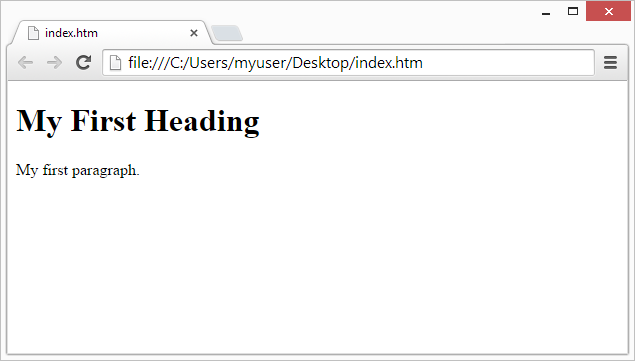
Result:

Important note:
·         Html starts from start tag and ends with end tag.We have to close all tags.
·         We’ve to close all tags in html.

  • The DOCTYPE declaration defines the document type to be HTML
  • The text between <html> and </html> describes an HTML document
  • The text between <head> and </head> provides information about the document
  • The text between <title> and </title> provides a title for the document
  • The text between <body> and </body> describes the visible page content
  • The text between <h1> and </h1> describes a heading
  • The text between <p> and </p> describes a paragraph

HTML TAGS:
Html tags are the keywords of html that are sorrounded by angel braces <tag name> </tag name>
Ø  The tags commonly used as a pairs. Like <p> and </p>
Ø  Tags are start with simple <p> but ends with slash </p>
Ø  First tag is called opening tag or start tag and other is called closing tag or end tag.
WEB BROWSER:
     Web browser (Chorom, mozila , safari etc.) are use to read the html language and show them on internet. Web browser does not show the html tags but it determine the tags to show that how to display a web page.
  
There are many version are released of html . some of given below :
Version                                                   Release
Html
Html 2.0
Html 3.2
Html 4.1
Xhtml
Html 5
1991
1995
1997
1999
2000
2014


Take Care Next lecture/toturial will be uploaded soon. 
regard : Rana Sarmad

Monday, 23 November 2015

Loops Of Programming Language...

Loops Constructs                      Written By Rana Sarmad

Loop:
            A statement of a set of statements that is executed repeatedly is called Loop. The statement of a set of statements in a loop is executed for a specified  number of time until given condition remains true.

Types of Loops In Programming language:
                        The are three types of loops in programming language. These are given below:
1: While Loop
2: Do-While Loop
3: For loop

While loop:
            It’s  a Conditional loop statement. It is used to execute a statement(s) as long as the given condition remains true.

Syntax:
while(Condition)
{
            Statement(s)... ;
}

Condition: Condition consist of a relational expression. If it is true, the statement  or the set of statements given in the while loop is executed.

Statement: It represents the body of the loop. The compound statement(s) are written within the curly braces {}.

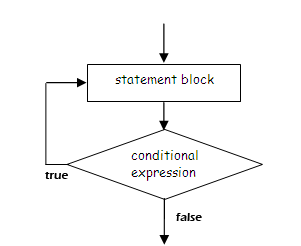
Flow Chart of The While Loop:

Do While Loop:
            It is same as the while lOop but in this loop the statement must be executes at least once.  After then the condition of the loop will be checked.
Simply in this loop the body of the loop executed before the condition.

Syntax:
do
{
Statement(s)... ;
}
while(Condition);
do : It’s simply meaning is do(Karo) in Simply word we can use  the word__Execute__ here.  the body of the loop execute first.

Statement : It’s represents the body of the loop.

Condition: it is the condition . if it is true the body of the loop execute again otherwise it’ll not.

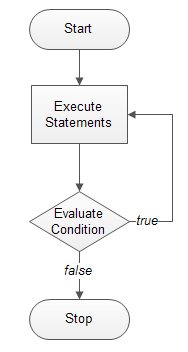
Flow Chart of the Do-while loop

The Difference between While and do-while loop


               ( while Loop )                     ( do-while Loop )

         ·   The test condition comes before the body of the loops. First condition check and then body execute if the condition is true.
          ·  The while statement does end with the semicolon (;).
              
        ·  The test condition comes after the body of the loop. First body executes and then condition is checked. The body will executes if conditon become true.otherwise not.
           · The while statement ends with semicolom.


For Loop:
            The “For Loop” statement or loop is used to execute a set statement repeatedly  for a specified number of times. It is also know as the counter loop.

Syntax:
            for(initialization; condition; increment/decrement)
_______________it’s the syntax and after then it’s body.
{
Statements ;
}

Initialization: in initialization the variable assigned to an initial value. More than one value may be initialize. For example:
for(a = 6, b = 5, a<10; a++)
Condition , Increment , Decrements  are we read previous.
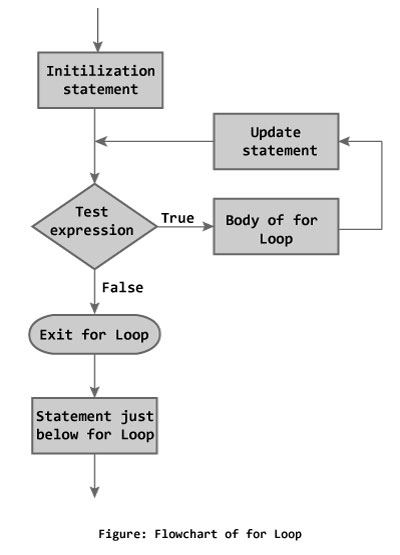
Flow Chart of for Loop


The Nested Loop : 
                        A Loop  structure completely inside the body of the another loop structure is called nested loop. The following points should be considered while writing the nested loop 

  • Nesting can be done up to any level . However, as the level of nesting increased, the loop structure becomes more complex.
  • Any loop structure can be placed within any other loop structure. for example, a "do while Loop"  may be placed within the "for loop" or "while loop"
The concept of nested loops is explained in the following program which will print asteriks (*) According to the pettern shown below:


* * * * *
* * * * 
* * *
* * 
*

#include <stdio.h>
void main (void)
{
     int       inner, outer ;
    for (outer = 5 ; outer >= 1 ; outer --)
        {
            ineer = 1 ;
            while (inner <= outer)
                     {
                         printf("*") ;
                         inner ++ ;
                      }
            printf("/n") ;
          }
}


In the above program... 
  • The while loop is used inside the body of the for  loop. the while loop is, therefore, the nested loop. the for loop is the outer loop. 
  • the outer loop is executed 5 times. 
  • For each iteration (Repeatation) of the outer loop, the inner loop executes until the value of the variable becomes outer. thus with each iteration of the outer loop, the number of iteration of the inner loop decreases....

Click here for Download